Showing posts with label Taiwan Politics. Show all posts

Sunday, March 23, 2008

Ma Yingjiu (馬英九) - Taiwan's new Prez!


Elections in Taiwan usually leave me a little conflicted. I'm no fan of the KMT, or even of the Republic of China - I identify with Taiwan, not the R.O.C. However, I think the party that usually claims to represent Taiwan (as opposed to the R.O.C.) has been a huge disappointment over the last eight years, and throughout the campaign. And the opposition candidate, Ma Yingjiu (Yes, I know he spells it Ying-jeou, but I prefer the standardized romanization of the Hanyu Pinyin system, so sue me.)is a candidate that has a lot of potential to do good. He promotes internationalization, not localization. He wants to get flights going between China and Taiwan - daily! He should be able to get a much -needed arms bill passed in the legislature, and most importantly, he'll have the support of a very blue (blue means KMT) legislature to implement his agenda. If Frank Xie had won, he would have been a lame-duck president, and probably even recalled. That would not have been good for the country.

The KMT has enough bad apples inside to make me nervous, though. They still have strong ties to organized crime, and they are already showing an arrogance of power. And while most KMT supporters pay lip service to the notion of a single China, some deluded old geezers in the KMT actually want that day to come!

I have a lot of faith in the people of Taiwan to not put up with anything to outrageous. The KMT's decisive victory aside, I believe that "Taiwan consciousness" is as strong as ever. It's now time for the opposition DPP to lick its wounds, and come back stronger and smarter. To be honest, they deserved this defeat. Their administration had become an embarrassment - corruption, insider trading scandals, a totally incompetent Ministry of Education, and a Government Information Office that was so hopeless, it was almost funny.

Sunday, March 16, 2008

Taiwan's Politicians are Dorks!


Today's Taipei Times writes:
The DPP has asked its supporters to:
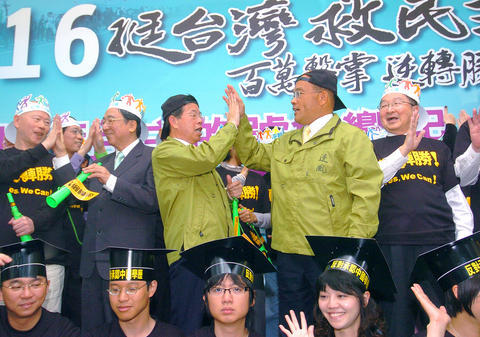
1. attend a campaign rally, dubbed "Million People High Five, Come-back Win"
2. to wear their baseball caps backward
3. flash the thumbs-up sign
4. exchange high fives
5. form a 1,000km line encircling much of Taiwan,
6. at 3:14 pm begin a 5km march in a counter-clockwise direction to symbolize "reversing the tide" against the KMT's dominance


The Million People High Five Come-back Win? Couldn't they think of a cheezier name? I'm surprised they're not also asking Taiwanese people to do the Macarena whilst taking out the garbage in green undies!

Of course, the KMT are no better - they don't even have original wackiness - they have to borrow the DPP's:
The KMT is holding simultaneous marches throughout the country, in which participants will wear their caps backward and exchange high fives at 3:14pm. The KMT yesterday brushed off the DPP's criticism, saying that wearing a hat backward symbolizes an athlete's determination to win by giving his or her last best shot.
"It is a gesture well known to sports lovers. It was not invented by the DPP," KMT communication and cultural committee head Huang Yucheng (黃玉振) said.


Edit: And I just noticed the DPP T-Shirts in the picture: "Yes, we can".

Frank Xie = Barack Obama?

Sure he does! Hahahahahahaha

Thursday, January 24, 2008

An Open Letter to Frank Xie and Ma Yingjiu

Thanks to Michael Turton for posting this first in his fine blog, The View from Taiwan.

This morning Apple Daily published an open letter from respected Taiwan scholar Bruce Jacobs, directed at the two presidential candidates.

+++++++++++++

An Open Letter to Frank Hsieh and Ma Ying-jeou
(給謝長廷和馬英九一封公開信)

By Bruce Jacobs (家博)

Over eighty per cent of the residents of Taiwan (台灣住民) want this country (本國)to be a member of the United Nations. As both of you have recognized in the past, this country is a sovereign nation (有主權的國家). According to international law, the best definition of a sovereign nation appears in the “Convention On Rights And Duties Of States” signed in Montevideo on December 26, 1933. According to this Treaty, a sovereign state has four characteristics: “a ) a permanent population; b ) a defined territory; c ) government; and d) capacity to enter into relations with the other states.” This nation clearly has all four of these characteristics. In addition, the people of this nation freely and democratically elect the nation’s government.

This clear unity among the people of this nation in desiring to participate in the United Nations has been lost in partisan bickering. I urge you both to put aside partisan interests and to concentrate on national interests.

In order to demonstrate to the world the desire of the people of this nation to belong to the United Nations, I would urge you both to reach a three-point agreement:

1. In discussing membership of the United Nations, you put aside the issue of “name” and do not refer to “Taiwan” or the “Republic of China.” In discussing membership of the United Nations, you can both refer to “this country” (本國).
2. In discussing membership of the United Nations, you put aside the issue of whether this country shall “join the United Nations” (入聯) or “return to the United Nations (返聯).” Rather, you can both refer to “participating in the United Nations” (參加聯合國).
3. You both urge all voters to support both UN referenda in the March 22 election.

With both of you supporting the two referenda, it is highly likely that both referenda will pass. This will send an important message to the world community that this nation is a sovereign nation that both wants and deserves to be a member of the United Nations. On the contrary, failing to pass the two referenda would send exactly the wrong message to the world community.

Such an agreement between the two of you would also go far towards diminishing political division in this nation and help to forge a new national unity.

Respectfully yours,

J. Bruce Jacobs (家博)

作者為澳洲蒙納士大學亞洲語言與研究講座教授暨台灣研究室主任.

+++++++++++++++


Of course nothing will happen. The KMT has no vision, and the DPP has no finesse (although I suspect Frank Xie might.) Whatever - Jacobs is right, regardless.

Sunday, January 13, 2008

KMT wins by a landslide


So Saturday we had legislative elections here in Taiwan, and the Chinese Nationalist Party, aka the Kuomintang (KMT), won by a landslide.

I have mixed feelings. I've grown increasingly disgusted with Chen Shuibian's administration over the last eight years. He has proved himself to be just as corrupt and ineffectual as any KMT president. The insider trading scandal involving his family members was also shameful, and he never properly acknowledged that betrayal, I feel. His cabinet was also a joke. He went through premiers faster than he went through clean socks, his Ministry of Education and the Government Information Office both became weekly, if not daily subjects of scorn and ridicule in the public eye thanks to the words and actions of their chiefs.

Still, I expect the media to interpret this election entirely incorrectly. Already I'm reading that this is a move towards China, i.e. unification, but I don't think that's correct. I don't believe that there are any significant numbers of people in Taiwan that want political unification with China, but I also don't believe most people are in favor of the cultural de-sinification that's become an important part of the DPP's bentuhua or localization policy.

I believe this election was a vote against localization, a vote against Chen Shuibian's administration, and a vote for change, although frankly, I think people are being a little naive in putting so much faith in Ma Yingjiu, the leader of the KMT and their candidate for the presidential election in two months. I haven't seen anything from him that suggests he has real leadership qualities. And I've heard nothing at all from him about his long-term vision for Taiwan. The KMT stresses that now is not the right time for unification, but of course the underlying message is that at some point it will be the right time for unification, which is something to which I'm deeply opposed. Taiwan's politics might be silly, but China's politics are dark, twisted, and evil. I wouldn't want my daughter growing up under such a horrible regime. The DPP, for all of its other mistakes has always gotten the long-term vision thing right: Taiwan is independent of China, and should remain so, and all countries that support freedom and democracy should recognize Taiwan's right to choose its own path, without threats of missile attacks, invasion


From the New York Times:

President Chen Shuibian resigned as chairman of the ruling Democratic Progressive Party immediately after the extent of the defeat became clear.

''I should shoulder all responsibilities,'' Chen said. ''I feel really apologetic and shamed.''

Tuesday, January 08, 2008

China's "peace" is sugar-coated poison (Chicago Tribune)

I saw the link to this article from Michael Turton's blog, The View from Taiwan. Thanks, Michael!

By Dennis V. Hickey
January 6, 2008


Taiwan and mainland China have been separated since Chiang Kai-shek's Kuomintang (KMT) government retreated to Taiwan in 1949. Taiwan is now a multiparty democracy led by President Chen Shui-bian of the Democratic Progressive Party (DPP), a party that favors "self-determination" for the island.

On Oct. 15, Hu Jintao, China's president, opened the 17th Chinese Communist Party (CCP) Congress by calling for a "peace agreement" with Taiwan. That move represents the latest in a series of "soft measures" intended to court key constituencies within Taiwanese society. Some suspect these changes are superficial, given that China has accelerated the campaign to isolate Taiwan in the global community and has deployed almost 1,000 ballistic missiles directly opposite the island. But others disagree.

In a recent interview, excerpted below, President Chen discussed China's policy toward Taiwan.

Q Some say China's policies toward Taiwan are changing. What is your interpretation?

A The nature of the CCP and its basic policy toward Taiwan never changes. It has one objective -- to annex Taiwan. The strategies have one goal -- to downgrade, localize, marginalize, undermine and delegitimize Taiwan's government and sovereignty.

Some say China's "soft policies" are getting "softer," while its "hard policies" are getting "harder." The real point is that "the hard is getting harder." We see the soft policies as sugar-coated poison. Many are deceived by this superficial change. China wants to annex Taiwan no matter which party is in power in Taipei. The only difference is that some Chinese leaders are more straightforward, while others know how to disguise their ambitions.

Q Why is China deploying missiles opposite Taiwan and squeezing Taiwan internationally while calling for a peace treaty?

A If you look at Hu Jintao, he is a formidable and sharp person. We need to be very careful and vigilant. Hu has called for a peace treaty with Taiwan, so people ... overlook the preconditions set for this treaty, which is "one China." They want to annex Taiwan and turn it into a province.

After China passed its ... "anti-secession law" in 2005 to lay a legal foundation for an invasion of Taiwan, the international community reacted negatively. So they came up with a strategy to invite Taiwan opposition party leaders to visit China. These politicians have accepted the "one-China principle." They are helping China.

Q Why wouldn't a return to the "one-China principle" lead to peace with China?

A Past presidents of Taiwan supported the idea of eventual unification with China. Did this lead to peace? In the 1950s, [Chinese leaders] threatened to "wash Taiwan with blood." In the 1990s, they fired missiles at Taiwan. China's threats and diplomatic oppression of Taiwan did not stop because the KMT accepted the one-China principle and the goal of ultimate unification.

Q Taiwan's opposition Chinese Nationalist Party, known as the KMT, is reaching out to the Chinese Communist Party, and leaders of the two parties have met. Any comment?

A This is just part of China's "united front" tactics and divide-and-conquer strategy. The KMT has not learned any lessons from the past. When they are of no use or value anymore, the CCP will throw them away like rubbish.

Q Were you surprised by President Hu's call for peace?

A No, it's just a strategy to deceive our people and foreign countries. Taiwan and China are two independent countries. Neither exercises jurisdiction over the other. Taiwan is Taiwan. China is China. There are two countries, one on each side of the Taiwan Strait. No matter how fierce China's united-front tactics may become, we will not accept the one-China principle or that unification is the only option for Taiwan. If Hu Jintao abandons the one-China principle, I will be surprised. If China gives up its one-party dictatorship, renounces the use of force against Taiwan and removes the 988 missiles deployed opposite Taiwan, then I will be truly surprised.

Q Are chances for peace between Taiwan and China increasing or decreasing?

A During my two terms as president, we've maintained peace in the Taiwan Strait, although my political opponents predicted war if I was elected. We have been vigilant, cautious and careful. We are proud of this. China's threats will increase in the future. Our next president must have great political wisdom and place our national interests first.

Q How should the U.S. promote peace and stability between China and Taiwan?

A Washington should support Taiwan's democratic development, promote official talks between the governments of China and Taiwan, review the outdated one-China policy and abide by the Taiwan Relations Act -- the law that governs relations between our countries. It should sell Taiwan defensive weapons and otherwise help this country defend itself.

When we hold our referendum on Taiwan's participation in the UN [in March], we hope the U.S. will have a positive attitude toward it. The reason Taiwan enjoys its democracy today is because of the encouragement and support of the U.S. government and American people. We want to make the voice of the Taiwanese people heard throughout the world and to become a formal member of international organizations.

----------

Dennis Hickey is director of the graduate program in international affairs at Missouri State University.

Sunday, January 28, 2007

"We Don't Need No Education"

At least not if Education Minister Du Zhengsheng (杜正勝) is leading the way. As the Taipei Times reports:
Du proved unpopular as head of the Ministry of Education from the start with the pan-blue camp, ruffling their feathers in 2004 with his proposal that Taiwan maps be rotated 90 degrees counter-clockwise in schools nationwide.

With the country's north no longer on top, Du argued, students could appreciate Taiwan from a fresher, "fairer" angle.
He's also been compared to George Bush for his apparent lack of literacy, which is a pretty glaring flaw in an education minister. He's been criticized in the past for dismissing Chinese idioms, a rich part of Chinese literary culture, as something which "makes one's brain rusty" and is not something to be included in a modern Chinese education. This may or may not be true (I suspect it isn't), but his gaffe over the weekend shows what an ignoramus really is.
Last week, Du defended his ministry's listing of the phrase "three little pigs" in its online classical idioms dictionary, insisting that the saying - apparently from the Western fairy tale by the same name - was indeed a classical Chinese idiom.

"For example, if I saw a student slacking off, I could say to him, `Don't be like the oldest of the three little pigs.' You see, that's an idiom," Du reportedly said.

Incidentally, in the fairy tale The Three Little Pigs, the oldest pig character outsmarts a villainous wolf by being hardworking.

Du's allegedly iffy grasp of idioms prompted pan-blue lawmakers to cook up their own "idiom" last week: "To pull a Du Zhengsheng," referring to verbal gaffes exposing one's ignorance.
And to make matters worse for the embattled education minister, the media reported that his son was seen partying with scantily-clad escort girls in a hostess bar, a violation of servicemen conduct codes.

I have no problem that a young soldier was out sowing his wild oats - that's what young soldiers do, but the public reaction was interesting. While watching some TV interviews with members of the public, I noticed that many people placed the blame on Du's son's moral failings on a faulty education system. "They just don't teach proper values in the schools anymore!" was the recurring theme, which to me is a funny thing to say. I don't want the school system here to teach my kid values. That job belongs to Vanessa and me. In fact, I think in the future I'll have to make a point of telling any of Trudi's teachers to please not teach her any values - she's being home-schooled in that department. She certainly won't be any worse off than her Taiwanese peers.

Saturday, January 27, 2007

Independence? No. Reunification? Ummmm.

So the Taipei Times is reporting that Ma Yingjiu (馬英九) is saying "no" to Taiwan Independence. Big whoop. That's an easy thing to say here - almost everyone, after all, is afraid of the consequences of a full-out conflict with China. However, just saying "no" to something isn't enough, in my view. He's got to say what he stands for, and run on it. I'm talking vision beyond the political landscape of 2007. How about vision for the political landscape of 2017, or even 2012? Of course Ma's party, the Kuomintang, was founded on the concept of One China - the full name is the Zhongguo Guomindang (中國國民黨), which translates as The Nationalist Party of China - but if Ma is really serious about reunification, let's hear how he thinks, or hopes, that might work. I'd like to hear him express his dream to Joe Taiwan about how he'd like to establish a system that would have people in Taiwan under the rule of a Beijing president, even a democratic one. Of course he couldn't - it would be political suicide. Just one more politician with no courage and no convictions.